05 Sep
What are Plosives?
Plosive is a fancy name for a sound that pops.
There are three plosives in English that you’ll want to focus on to make sure your speech is clear.
They are T, P and K sounds, like you’ll find in the following words:
- tie
- pill
- Kate
- coal
As the name implies, a plosive sound should be explosive!
For a clearly intelligible plosive sound, you need to make sure that you produce a noisy puff of air when saying these sounds.
If you don’t produce that pop, your listener will either hear a different word or most likely won’t understand what you said at all.
Confusing Similar Sounds
Linguistically, T, P, and K sounds are voiceless stops.
- Voiceless means they are produced without using your vocal cords. The sound is produced only by air flowing through the mouth.
- A stop consonant is one that stops the air flow completely and then releases it.
Can you distinguish between voiceless and voiced stop pairs?
- T and D: tie vs die
- P and B: pill vs bill
- K and G: Kate vs gate or coal vs goal
Note that our K sound in English is most frequently spelled with the letter C.
If you’re not pronouncing these pairs differently, then the listener will probably struggle to understand your T, P, and K sounds.
Who Should be Concerned about Plosives?
Mastering the plosive sound is most crucial for native speakers of languages spoken in India and nearby countries like Pakistan, Bangladesh, and Nepal.
Many native Spanish and Russian speakers, as well as several other Asian and Slavic languages, also often benefit from fine-tuning their plosives.
Indian languages tend to hold sounds deep inside the mouth, while English tends to bring sounds forward and push sounds out of the mouth more.
If your mother tongue is an Indian language, you’ll want to envision a shift in sound focus. The vast majority of English sounds are produced in the front of the mouth.
Spanish speakers should be careful to make sure that their tongue placement is correct for the T sound.
To pronounce the plosive T, the tip of the tongue should be firmly touching the alveolar ridge, which is on the roof of your mouth, where the skin meets your upper front teeth.
Your Spanish T may sit farther forward, with the front of your tongue touching the back of your upper front teeth.
Why are Plosives Important?
It’s really amazing how this one small change in your speech dramatically affects your clarity.
Often when I work with someone, it’s one of the first things that we address.
This is for several reasons.
- Correctly pronouncing plosives can have a huge positive effect on your intelligibility.
- These sounds occur frequently, so they affect a lot of words.
- Integrating plosives into your speech is easy to accomplish quickly.
Initial Plosives
Not all T, K, and P sounds are plosives.
T, K, and P have a dramatic puff of air only when they begin a stressed syllable.
Stressed syllables in English very often begin words.
Word stress rules are a little bit complicated, but English has the tendency to default to stressing the first syllable, so your initial T, K, and P sounds usually pop.
Here are several words that are stressed on the first syllable, so they have a plosive:
- team, Tuesday, technology
- car, currently, conversation
- parent, please, party
Hear the words here and repeat them after me:
Say each sentence below, making sure to pop on the plosives. Words with plosives are bolded.
- Can you come on Tuesday at 2:00?
- 20 people came to the party.
- Kate is my current partner.
- Please plan to arrive on time.
Listen to the audio and repeat these sentences after me:
Middle Plosives
Although you’ll most often find plosives at the beginning of words…
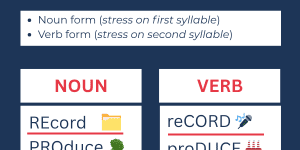
…it’s not uncommon to stress the second syllable in a word…
…especially when it comes to verbs.
So occasionally, there are plosives in the middle of words.
Here are some examples of words that stress the second syllable:
- plosive T: fifteen, attention, control
- plosive K: account, include, according
- plosive P: repeat, computer, appointment
Hear the words here and repeat them after me:
The bolded words here all have a middle plosive sound.
- There were 15 participants according to the report.
- Sometimes, they include potatoes in this dish.
- The external accounts aren’t under our control.
- Let’s compare different options to maintain our computer systems
Listen to the audio and repeat these sentences after me:
Next Steps:
Keep practicing using the audio above.
This one little change in your speech can have a huge impact on your clarity.
So if plosives are a challenge for you. I encourage you to make it a priority to master them.
And you’ll probably find it surprisingly simple to do.
Need help? Not sure if you’re getting it right? Want feedback?
Book a free consultation to find out more about working with English coach Nicole.